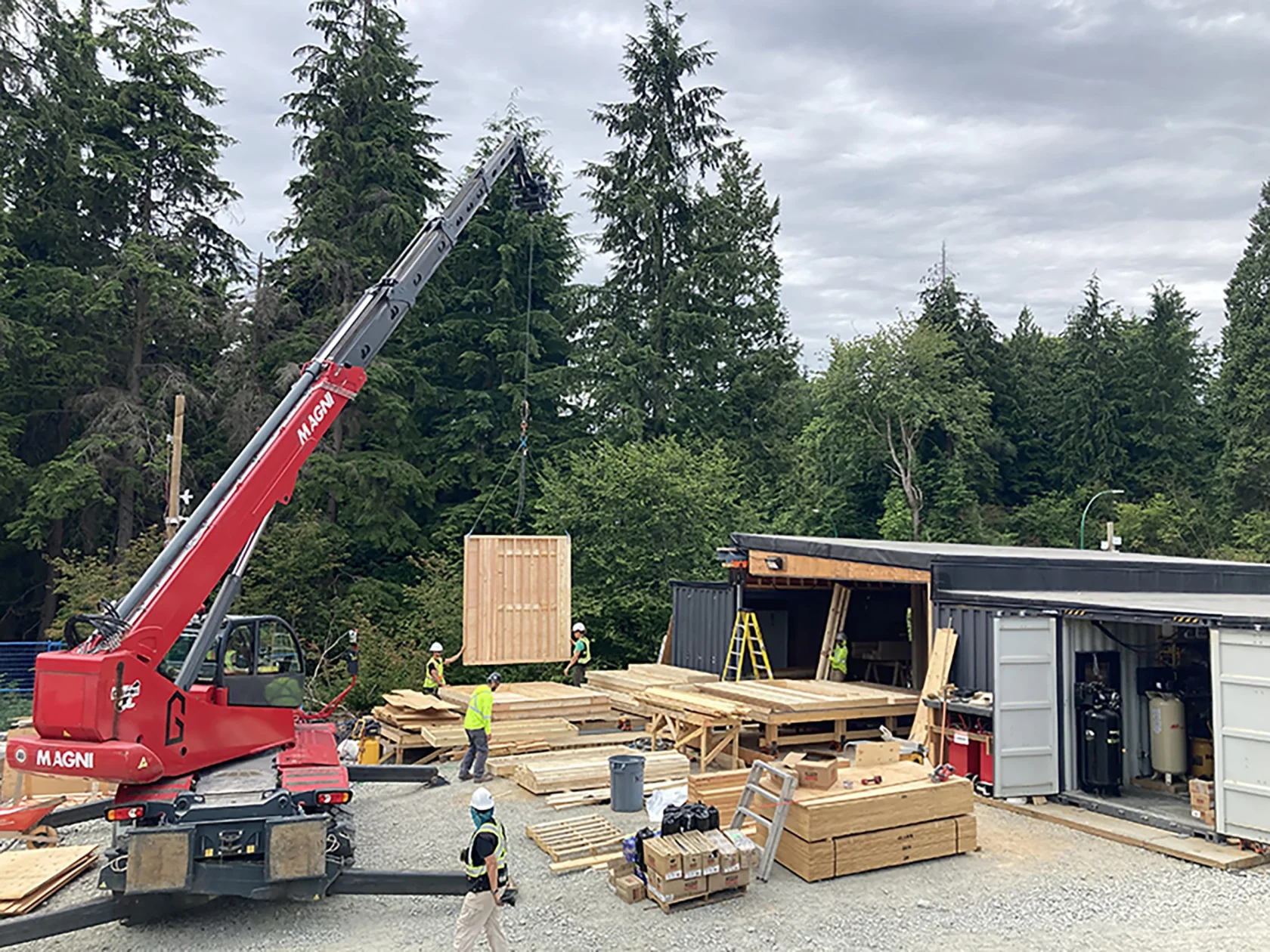
Production Automation feasibility for a “Flying Factory” Model
Automation and advanced manufacturing technologies for mobile prefabricated housing delivery.
Project Overview
Updated December 15, 2025.
The Problem
From a builder’s point of view, British Columbia’s housing industry is facing two concurrent crises. The first is a shortage of skilled labour, with not enough new hires to replace retiring workers. The second is productivity in the construction sector has not kept pace with other sectors in recent decades.
Prefabricated housing offers a promising solution to dramatically improve speed and quality of housing in B.C. Yet, the industry has struggled to create a sustainable business model. Fixed costs remain too high, designs lack standardization to achieve economies of scale, and delivery bottlenecks are causing excessive schedule changes and rework. This struggle has been especially acute in rural and remote communities in B.C., despite the fact these communities are where prefabricated housing is needed most.
How We Are Solving It
Naikoon Contracting is advancing a prefabrication facility known as the “Flying Factory™,” testing practical automation and advanced technologies that can improve production outcomes in mobile manufacturing environments, while also creating jobs and supporting trades training and upskilling.
Developed as a state-of-the-art, mobile, digitally sophisticated prefabrication facility, the “Flying Factory™” is designed to bring housing component manufacturing closer to the build site, saving time and, as a result, money. The production plant can be packed into shipping containers that fit onto two B-train truck trailers, transported to a new location, and reconfigured to support successive projects, thereby avoiding the costly overhead of a permanent facility.
This project focused on technologies most likely to improve operational efficiency in current Flying Factory operations, particularly the speed and accuracy of panel manufacturing, product tracking, and quality control, while also streamlining training and simplifying set-up and handoff.
The project evaluated a wide range of options through an operational lens, including robustness in a mobile environment, ease of set-up and reconfiguration, required skills for operation, and potential return on investment.
Technologies evaluated and/or tested include:
-
Digital shop drawings projected on iPads or TV screens to eliminate paper and speed up revisions on the shop floor
-
AR/VR-assisted assembly, including projection-based approaches that reduce the need for headsets and improve ease of reference during assembly and inspection
-
Printing and marking systems for consistent panel identification and potential QR-linked access to drawings and panel metadata
-
Layout and workflow optimization, including assessing the value of location tracking versus direct observation of bottlenecks and iterative workflow refinement
Ultimately, this project aims to establish a replicable, operations-focused approach to Flying Factory production that improves throughput, strengthens quality control, and supports consistent training and maintenance practices, allowing the model to be repeated effectively across multiple projects and locations.